This blog collects some of my notes on classical computational learning theory, based on my reading of Kearns and Vazirani. The results are (almost) all from their book, the sloganising (and mistakes, no doubt) are mine.
The Probably Approximately Correct (PAC) Framework
Definition (Instance Space). An instance space is a set, typically denoted  . It is the set of objects we are trying to learn about.
Definition (Concept). A concept  over is a subset of the instance space .
Although not covered in Kearns and Vazirani, in general it is possible to generalise beyond Boolean membership to some degree of uncertainty or fuzziness – I hope to cover this in a future blog post.
Definition (Concept Class). A concept class  is a set of concepts, i.e.
  , where
  denotes power set. We will follow Kearns and Vazirani and also use to denote the corresponding indicator function
  .
.
In PAC learning, we assume is known, but the target class  is not. However, it doesn’t seem a jump to allow for unknown target class, in an appropriate approximation setting – I would welcome comments on established frameworks for this.
Definition (Target Distribution). A target distribution  is a probability distribution over .
In PAC learning, we assume is unknown.
Definition (Oracle). An oracle is a function  taking a concept class and a distribution, and returning a labelled example
  where
where  is drawn randomly and independently from .
Definition (Error). The error of a hypothesis concept class  with reference to a target concept class and target distribution , is
  , where
  denotes probability.
Definition (Representation Scheme). A representation scheme for a concept class is a function  where
where  is a finite alphabet of symbols (or – following the Real RAM model – a finite alphabet augmented with real numbers).
Definition (Representation Class). A representation class is a concept class together with a fixed representation scheme for that class.
Definition (Size). We associate a size  with each string from a representation alphabet
  . We similarly associate a size with each concept via the size of its minimal representation
  .
.
Definition (PAC Learnable). Let and  be representation classes classes over , where
  . We say that concept class is PAC learnable using hypothesis class if there exists an algorithm that, given access to an oracle, when learning any target concept over any distribution on , and for any given
  and
and  , with probability at least
  , outputs a hypothesis
  with
with  .
.
Definition (Efficiently PAC Learnable). Let  and
and  be representation classes classes over
  , where
  for all
  . Let
. Let  or
or  . Let
. Let  ,
,  , and
, and  . We say that concept class is efficiently PAC learnable using hypothesis class if there exists an algorithm that, given access to a constant time oracle, when learning any target concept
  over any distribution on , and for any given and :
- Runs in time polynomial in ,
 ,
,  , and
, and  , and
, and
- With probability at least , outputs a hypothesis with .
There is much of interest to unpick in these definitions. Firstly, notice that we have defined a family of classes parameterised by dimension , allowing us to talk in terms of asymptotic behaviour as dimensionality increases. Secondly, note the key parameters of PAC learnability:  (the ‘probably’ bit) and
  (the ‘approximate’ bit). The first of these captures the idea that we may get really unlucky with our calls to the oracle, and get misleading training data. The second captures the idea that we are not aiming for certainty in our final classification accuracy, some pre-defined tolerance is allowable. Thirdly, note the requirements of efficiency: polynomial scaling in dimension, in size of the concept (complex concepts can be harder to learn), in error rate (the more sloppy, the easier), and in probability of algorithm failure to find a suitable hypothesis (you need to pay for more certainty). Finally, and most intricately, notice the separation of concept class from hypothesis class. We require the hypothesis class to be at least as general, so the concept we’re trying to learn is actually one of the returnable hypotheses, but it can be strictly more general. This is to avoid the case where the restricted hypothesis classes are harder to learn; Kearns and Vazirani, following Pitt and Valiant, give the example of learning the concept class 3-DNF using the hypothesis class 3-DNF is intractable, yet learning the same concept class with the more general hypothesis class 3-CNF is efficiently PAC learnable.
Occam’s Razor
Definition (Occam Algorithm). Let  and
and  be real constants. An algorithm is an
  -Occam algorithm for using if, on an input sample
  of cardinality
  labelled by membership in , the algorithm outputs a hypothesis such that:
 is consistent with , i.e. there is no misclassification on
Thus Occam algorithms produce succinct hypotheses consistent with data. Note that the size of the hypothesis is allowed to grow only mildly – if at all – with the size of the dataset (via  ). Note, however, that there is nothing in this definition that suggests predictive power on unseen samples.
Definition (Efficient Occam Algorithm). An -Occam algorithm is efficient iff its running time is polynomial in , , and .
Theorem (Occam’s Razor). Let  be an efficient -Occam algorithm for using . Let be the target distribution over , let be the target concept,
  . Then there is a constant
  such that if is given as input a random sample of examples drawn from oracle , where satisfies
  , then runs in time polynomial in , , and
  and, with probability at least
  , the output of satisfies
  .
.
This is a technically dense presentation, but it’s a philosophically beautiful result. Let’s unpick it a bit, so its essence is not obscured by notation. In summary, simple rules that are consistent with prior observations have predictive power! The ‘simple’ part here comes from , and the predictive power comes from the bound on  . Of course, one needs sufficient observations (the complex lower bound on ) for this to hold. Notice that as approaches 1, and so – by the definition of an Occam algorithm – we get close to being able to memorise our entire training set – we need an arbitrarily large training set (memorisation doesn’t generalise).
Vapnik-Chervonenkis (VC) Dimension
Definition (Behaviours). The set of behaviours on  that are realised by , is defined by
  .
.
Each of the points in is either included in a given concept or not. Each tuple  then forms a kind of fingerprint of according to a particular concept. The set of behaviours is the set of all such fingerprints across the whole concept class..
Definition (Shattered). A set is shattered by iff  .
.
Note that  is the maximum cardinality that’s possible, i.e. the set of behaviours is all possible behaviours. So we can think of a set as being shattered by a concept class iff there’s no combination of inclusion/exclusion in the concepts that isn’t represented at least once in the set.
Definition (Vapnik-Chervonenkis Dimension). The VC dimension of , denoted  , is the cardinality of the largest set shattered by . If arbitrarily large finite sets can be shattered by , then
  .
.
VC dimension in this sense captures the ability of to discern between samples.
Theorem (PAC-learning in Low VC Dimension). Let be any concept class. Let be any representation class off of VC dimension  . Let be any algorithm taking a set of labelled examples of a concept and producing a concept in that is consistent with the examples. Then there exists a constant
  such that is a PAC learning algorithm for using when it is given examples from , and when
  .
.
Let’s take a look at the similarity between this theorem and Occam’s razor, presented in the last section of this blog post. Both bounds have a similar feel, but the VCD-based bound does not depend on ; indeed it’s possible that the size of hypotheses is infinite and yet the VCD is still finite.
As the theorem below shows, the linear dependence on VCD achieved in the above theorem is actually the best one can do.
Theorem (PAC-learning Minimum Samples). Any algorithm for PAC-learning a concept class of VC dimension must use  examples in the worst case.
Definition (Layered DAG). A layered DAG is a DAG in which each vertex is associated with a layer  and in which the edges are always from some layer
  to the next layer
  . Vertices at layer 0 have indegree 0 and are referred to as input nodes. Vertices at other layers are referred to as internal nodes. There is a single output node of outdegree 0.
Definition ( -composition). For a layered DAG and a concept class , the G-composition of is the class of all concepts that can be obtained by: (i) associating a concept
  with each vertex
  in , (ii) applying the concept at each node to its predecessor nodes.
Notice that this way we can think of the internal nodes as forming a Boolean circuit with a single output; the -composition is the concept class we obtain by restricting concepts to only those computable with the structure . This is a very natural way of composing concepts – so what kind of VCD arises through this composition? This theorem provides an answer:
Theorem (VCD Compositional Bound). Let be a layered DAG with input nodes and  internal nodes, each of indegree
  . Let be a concept class over
  of VC dimension , and let
  be the -composition of . Then
  .
.
Weak PAC Learnability
Definition (Weak PAC Learning). Let be a concept class and let be an algorithm that is given access to for target concept and distribution . is a weak PAC learning algorithm for using if there exist polynomials  and
and  such that outputs a hypothesis that with probability at least
  satisfies
  .
.
Kearns and Vazirani justifiably describe weak PAC learning as “the weakest demand we could place on an algorithm in the PAC setting without trivialising the problem”: if these were exponential rather than polynomial functions in , the problem is trivial: take a fixed-size random sample of the concept and memorise it, randomly guess with probability 50% outside the memorised sample. The remarkable result is that efficient weak PAC learnability and efficient PAC learnability coincide for an appropriate PAC hypothesis class, based on ternary majority trees.
Definition (Ternary Majority Tree). A ternary majority tree with leaves from is a tree where each non-leaf node computes a majority (voting) function of its three children, and each leaf is labelled with a hypothesis from .
Theorem (Weak PAC learnability is PAC learnability). Let be any concept class and any hypothesis class. Then if is efficiently weakly PAC learnable using , it follows that is efficiently PAC learnable using a hypothesis class of ternary majority trees with leaves from .
Kearns and Varzirani provide an algorithm to learn this way. The details are described in their book, but the basic principle is based on “boosting”, as developed in the lemma to follow.
Definition (Filtered Distributions). Given a distribution and a hypothesis  we define
  to be the distribution obtained by flipping a fair coin and, on a heads, drawing from until agrees with the label; on a tails, drawing from until disagrees with the label. Invoking a weak learning algorithm on data from this new distribution yields a new hypothesis
  . Similarly, we define
  to be the distribution obtained by drawing examples from until we find an example on which and disagree.
What’s going on in these constructions is quite clever: has been constructed so that it must contain new information about , compared to ; has, by construction, no advantage over a coin flip on  . Similarly,
  contains new information about not already contained in and , namely on the points where they disagree. Thus, one would expect that hypotheses that work in these three cases could be combined to give us a better overall hypothesis. This is indeed the case, as the following lemma shows.
Lemma (Boosting). Let  . Let the distributions , ,
  be defined above, and let , and satisfy
  ,
,  ,
,  . Then if
  , it follows that
  .
.
The function  is monotone and strictly decreasing over
  . Hence by combining three hypotheses with only marginally better accuracy than flipping a coin, the boosting lemma tells us that we can obtain a strictly stronger hypothesis. The algorithm for (strong) PAC learnability therefore involves recursively calling this boosting procedure, leading to the majority tree – based hypothesis class. Of course, one needs to show that the depth of the recursion is not too large and that we can sample from the filtered distributions with not too many calls to the overall oracle , so that the polynomial complexity bound in the PAC definition is maintained. Kearns and Vazirani include these two results in the book.
Learning from Noisy Data
Up until this point, we have only dealt with correctly classified training data. The introduction of a noisy oracle allows us to move beyond this limitation.
Definition (Noisy Oracle). A noisy oracle  extends the earlier idea of an oracle with an additional noise parameter
  . This oracle behaves in the identical way to
  except that it returns the wrong classification with probability
  .
.
Definition (PAC Learnable from Noisy Data). Let be a concept class and let be a representation class over . Then is PAC learnable from noisy data using if there exists and algorithm such that: for any concept , any distribution on , any , and any  ,
,  and
and  with
with  , given access to a noisy oracle and inputs , , , with probability at least the algorithm outputs a hypothesis concept with . If the runtime of the algorithm is polynomial in , , and
  then is efficiently learnable from noisy data using .
Let’s unpick this definition a bit. The main difference from the PAC definition is simply the addition of noise via the oracle and an additional parameter which bounds the error of the oracle; thus the algorithm is allowed to know in advance an upper bound on the noisiness of the data, and an efficient algorithm is allowed to take more time on more noisy data.
Kearns and Vazirani address PAC learnability from noisy data in an indirect way, via the use of a slightly different framework, introduced below.
Definition (Statistical Oracle). A statistical oracle  takes queries of the form
  where
where  and
and  , and returns a value
  satisfying
  where
where ![P_\chi = Pr_{x \in {\mathcal D}}[ \chi(x, c(x)) = 1 ]](https://s0.wp.com/latex.php?latex=P_%5Cchi+%3D+Pr_%7Bx+%5Cin+%7B%5Cmathcal+D%7D%7D%5B+%5Cchi%28x%2C+c%28x%29%29+%3D+1+%5D&bg=ffffff&fg=000000&s=0&c=20201002) .
.
Definition (Learnable from Statistical Queries). Let be a concept class and let be a representation class over . Then is efficiently learnable from statistical learning queries using if there exists a learning algorithm and polynomials  ,
,  and
and  such that: for any , any distribution over and any , if given access to
  , the following hold. (i) For every query
  made by , the predicate
  can be evaluated in time
  , and
, and  , (ii) has execution time bounded by
  , (iii) outputs a hypothesis that satisfies .
So a statistical oracle can be asked about a whole predicate , for any given tolerance  . The oracle must return an estimate of the probability that this predicate holds (where the probability is over the distribution over ). It is, perhaps, not entirely obvious how to relate this back to the more obvious noisy oracle used above. However, it is worth noting that one can construct a statistical oracle that works with high probability by taking enough samples from a standard oracle, and then returning the relative frequency of evaluating to 1 on that sample. Kearns and Vazirani provide an intricate construction to efficiently sample from a noisy oracle to produce a statistical oracle with high probability. In essence, this then allows an algorithm that can learn from statistical queries to be used to learn from noisy data, resulting in the following theorem.
Theorem (Learnable from Statistical Queries means Learnable from Noisy Data). Let be a concept class and let be a representation class over . Then if is efficiently learnable from statistical queries using , is also efficiently PAC learnable using in the presence of classification noise.
Hardness Results
I mentioned earlier in this post that Pitt and Valiant showed that sometimes we want more general hypothesis classes than concept classes: the concept class 3-DNF using the hypothesis class 3-DNF is intractable, yet learning the same concept class with the more general hypothesis class 3-CNF is efficiently PAC learnable. So in their chapter Inherent Unpredictability, Kearns and Vazirani turn their attention to the case where a concept class is hard to learn independent of the choice of a hypothesis class. This leads to some quite profound results for those of us interested in Boolean circuits.
We will need some kind of hardness assumption to develop hardness results for learning. In particular, note that if  , then by Occam’s Razor (above) polynomially evaluable hypothesis classes are also polynomially-learnable ones. So we will need to do two things: focus our attention on polynomially evaluable hypothesis classes (or we can’t hope to learn them polynomially), and make a suitable hardness assumption. The latter requires a very brief detour into some results commonly associated with cryptography.
Let  . We define the cubing function
  by
by  . Let
. Let  define Euler’s totient function. Then if is not a multiple of three, it turns out that
  is bijective, so we can talk of a unique discrete cube root.
Definition (Discrete Cube Root Problem). Let  and
and  be two -bit primes with
  not a multiple of 3, where
  . Given
  and
and  as input, output .
Definition (Discrete Cube Root Assumption). For every polynomial  , there is no algorithm that runs in time
  that solves the discrete cube root problem with probability at least
  , where the probability is taken over randomisation of , , and any internal randomisation of the algorithm . (Where ).
This Discrete Cube Root Assumption is widely known and studied, and forms the basis of the learning complexity results presented by Kearns and Vazirani.
Theorem (Concepts Computed by Small, Shallow Boolean Circuits are Hard to Learn). Under the Discrete Cube Root Assumption, the representation class of polynomial-size, log-depth Boolean circuits is not efficiently PAC learnable (using any polynomially evaluable hypothesis class).
The result also holds if one removes the log-depth requirement, but this result shows that even by restricting ourselves to only log-depth circuits, hardness remains.
In case any of my blog readers knows: please contact me directly if you’re aware of any resource of positive results on learnability of any compositionally closed non-trivial restricted classes of Boolean circuits.
The construction used to provide the result above for Boolean circuits can be generalised to neural networks:
Theorem (Concepts Computed by Neural Networks are Hard to Learn). Under the Discrete Cube Root Assumption, there is a polynomial and an infinite family of directed acyclic graphs (neural network architectures)  such that each
  has
has  Boolean inputs and at most
  nodes, the depth of is a constant independent of , but the representation class
  is not efficiently PAC learnable (using any polynomially evaluable hypothesis class), and even if the weights are restricted to be binary.
Through an appropriate natural definition of reduction in PAC learning, Kearns and Vazirani show that the PAC-learnability of all these classes reduce to functions computed by deterministic finite automata. So, in particular:
Theorem (Concepts Computed by Deterministic Finite Automata are Hard to Learn). Under the Discrete Cube Root Assumption, the representation class of Deterministic Finite Automata is not efficiently PAC learnable (using any polynomially evaluable hypothesis class).
It is this result that motivates the final chapter of the book.
Experimentation in Learning
As discussed above, PAC model utilises an oracle that returns labelled samples . An interesting question is whether more learning power arises if we allow the algorithms to be able to select themselves, with the oracle returning  , i.e. not just to be shown randomly selected examples but take charge and test their understanding of the concept.
Definition (Membership Query). A membership query oracle takes any instance and returns its classification .
Definition (Equivalence Query). An equivalence query oracle takes a hypothesis concept and determines whether there is an instance on which  , returning this counterexample if so.
Definition (Learnable From Membership and Equivalence Queries). The representation class is efficiently exactly learnable from membership and equivalence queries if there is a polynomial and an algorithm with access to membership and equivalence oracles such that for any target concept , the algorithm outputs the concept in time  .
.
There are a couple of things to note about this definition. It appears to be a much stronger requirement than PAC learning, as the concept must be exactly learnt. On the other hand, the existence of these more sophisticated oracles, especially the equivalence query oracle, appears to narrow the scope. Kearns and Vazirani encourage the reader to prove that the true strengthening over PAC-learnability is in the membership queries:
Theorem (Exact Learnability from Membership and Equivalence means PAC-learnable with only Membership). For any representation class , if is efficiently exactly learnable from membership and equivalence queries, then is also efficiently learnable in the PAC model with membership queries.
They then provide an explicit algorithm, based on these two new oracles, to efficiently exactly learn deterministic finite automata.
Theorem (Experiments Make Deterministic Finite Automata Efficiently Learnable). The representation class of Deterministic Finite Automata is efficiently exactly learnable from membership and equivalence queries.
Note the contrast with the hardness result of the previous section: through the addition of experimentation, we have gone from infeasible learnability to efficient learnability. Another very philosophically pleasing result.



 , then I may as well be computing
  . In both cases, the fundamental issue becomes how to identify whether a value will be unused later in a computation. Intriguingly, this question is tightly related to the way a computation is performed: there are many ways of computing a given mathematical computation, and each one will have its own redundancies to exploit.
 and equivalences expressing clock and data gating within the same rewriting framework. A collection of these latter equivalences are shown in the table below from our paper.




 for its inputs
  and bias
  , where
  is typically a fixed nonlinear function such as a
  . The Xilinx team noted that if they restrict the length of the vector
  . In this way, we can tune a knob: turn down to
  for minimal expressivity but the smallest number of parameters to train, and recover LogicNets as a special case; turn up
 elements,
  , for
, for  . The numbers represented are (except special values),
  . This is a very flexible starting point, which is to be welcomed, and there is much to explore under this general hood. In all the examples given, the scalar data types are either floating point or integer/fixed point, but there seems to be nothing in the specification specifically barring other representations, which could of course go far beyond traditional block floating point and more recent block exponent biases.
 denotes the
  th element of vector
  denotes the scaling of
  (on elements), the (elided) product on scalings and the sum on element products is undefined. The intention, of course, is that we want the dot product to approximate a real dot product, in the sense that
  , where the semantic brackets correspond to interpretation in the base scalar types and arithmetic operations are over the reals. But the nature of approximation is left unstated. Note, in particular, that it is not a form of round-to-nearest defined on MX, as hinted at by the statement “The internal precision of the dot product and order of operations is implementation-defined.” This at least suggests that there’s an assumed implementation of the multi-operand summation via two-input additions executed in some (identical?) internal precision in some defined order, though this is a very specific – and rather restrictive – way of performing multi-operand addition in hardware. There’s nothing wrong with having this undefined, of course, but an MX-compliant dot product would need to have a very clear statement of its approximation properties – perhaps something that can be considered for the standard in due course.
 and
and  are the
  th MX-compliant subvector of
  .” Like in the “Dot” definition, the summation notation is also not defined in the specification, and also this definition doesn’t carry the same wording as for “Dot” on internal precision and order, but I am assuming it is intended to. It is left undefined how to form component subvectors. I am assuming that the authors envisaged the vector
  and
and  are the extracted “close” expressions.
 can just be replaced by
  , e.g.
  . But our original ARITH paper wasn’t able to consider special cases. What we really need for that is some kind of conditional rewrite rules, e.g.
  , where I am using math script to denote the value of a variable and teletype script to denote an expression.
 . Now let’s imagine introducing a new operator
  that takes two expressions, the second of which is interpreted as a Boolean. Let’s give
  . In this way we can ‘lift’ equivalences in a subdomain to equivalences across the whole domain, and use e-graphs without modification to reason about these equivalences. Taking the absolute value example from previously, we can write this equivalence as
  . These
 ![x \in [-1,1]](https://s0.wp.com/latex.php?latex=x+%5Cin+%5B-1%2C1%5D&bg=ffffff&fg=000000&s=0&c=20201002) , then a classical evaluation of
, then a classical evaluation of  would give me
 ![[-2,2]](https://s0.wp.com/latex.php?latex=%5B-2%2C2%5D&bg=ffffff&fg=000000&s=0&c=20201002) , due to the loss of information about the correlation between the left and right-hand sides of the subtraction operator. Once again, our e-graph setting comes to the rescue! Taking this example, a rewrite
, due to the loss of information about the correlation between the left and right-hand sides of the subtraction operator. Once again, our e-graph setting comes to the rescue! Taking this example, a rewrite  would likely fire, resulting in zero residing in the same e-class as
  . Since the interval associated with
  is
is ![[0,0]](https://s0.wp.com/latex.php?latex=%5B0%2C0%5D&bg=ffffff&fg=000000&s=0&c=20201002) , the same interval will automatically be associated with
, the same interval will automatically be associated with 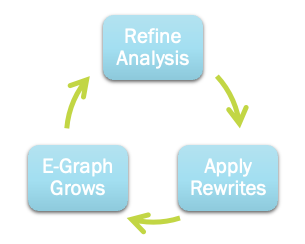

 George A. Constantinides